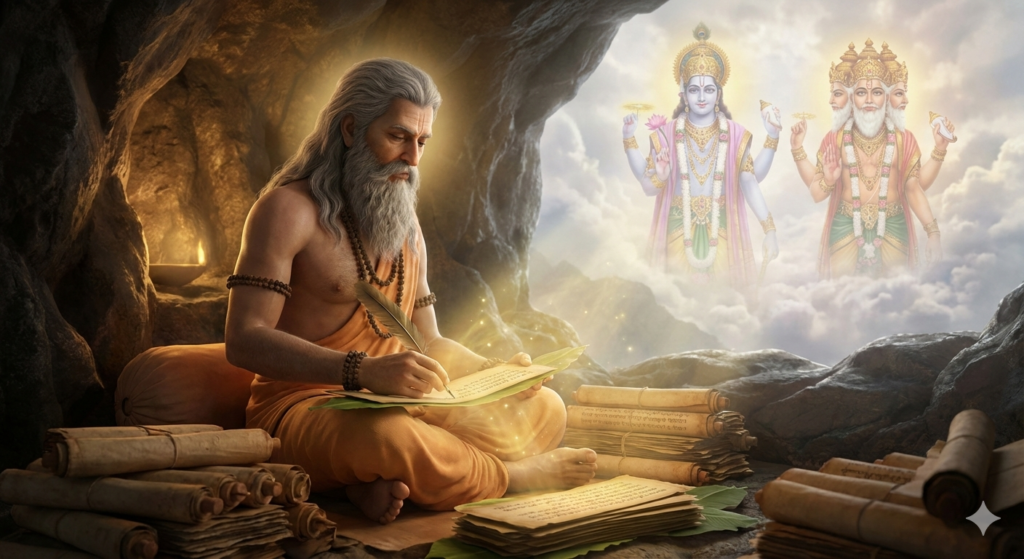
Puruvamsha Narration

Puru Vamshavruksha Family Tree Overview Image of Mahabharata

The Complete Family Tree from Brahma to the Pandavas of Mahabharata

Introduction

In the Mahabharata, the great epic of Indian Sanatan history, numerous royal dynasties are mentioned. Among them, the most sacred and glorious lineage, adorned with exceptionally heroic kings, is the ‘Puruvamsha‘. 

The Kauravas and Pandavas, who were central to the Mahabharata war, belonged to this great dynasty. Here is the fascinating description of this long lineage, starting from Lord Brahma down to the beginning of the Kali Yuga.

Lord Brahma to King Puru

Puruvamsha of Mahabharata. The image depicts the Puru vamsha vruksha or family tree starting from Lord Brahma to King Puru

The Dawn of Creation and the Arrival of Yayati and Puru

Lord Brahma, who is eternal and imperishable, was born from Narayana, the creator of the universe. 

To carry forward the work of creation, Brahma created Daksha Prajapati from his right thumb and Sage Marichi from his eyes. 

Subsequently, Kashyapa was born as the son of Marichi, and Aditi was born as the daughter of Daksha.

Vivasvata (the Sun) was born to the couple Kashyapa and Aditi. 

This Vivasvata had a son named Manu.

Ila was the daughter of Manu, and her son was Pururava

As the lineage progressed, Pururava begot a son named Ayu, and Ayu begot Nahusha

This Nahusha was the father of the famous King Yayati.

King Yayati had two wives: Devayani, the daughter of Shukracharya, and Sharmistha, the daughter of Vrishaparva

Devayani gave birth to two sons, Yadu and Turvashu.

Sharmistha gave birth to three sons, Druhyu, Anu, and Puru

Among the children of these two wives, the Yadava dynasty became famous through Yadu, while the renowned ‘Puruvamsha‘ was born through Puru.

King Puru to Emperor Bharata

Puruvamsha of Mahabharata. Puru vamsha vruksha or family tree from King Puru to King Bharata

The dutiful wife of King Puru, Princess Kausalya of Kosala kingdom, gave birth to Janamejaya.

Janamejaya‘s wife was Sunanda, and their son was Prachinvan.

Prachinvan‘s wife was Sushtuvaa, and their son was Shayyati.

Shayyati‘s wife was Varangi, the daughter of Trishanku, and their son was Ahampaati.

As the lineage continued, Ahampaati‘s wife Bhanumati, the daughter of Kritavirya, gave birth to Sarvabhauma.

Sarvabhauma‘s wife was Sundari, and their son was Jayatsena.

Jayatsena‘s wife was Sushrava, who gave birth to Aparachina.

Aparachina’s wife was Maryada, and her son was Ruksha.

Ruksha‘s wife was Vamadevi, and their son was also named Ruksha.

Ruksha’s wife was Jvalanti, the daughter of Takshaka, and their son was Antinara.

Antinara married a maiden from the banks of the Sarasvati River and begot a son named Trasu.

Trasu‘s wife was Kalindi, and their son was Ilila.

Ilila‘s son was the celebrated King Dushyanta. 

King Dushyanta married Shakuntala, the daughter of Sage Vishvamitra, through a Gandharva marriage and begot Bharata.

It is after this Emperor Bharata that our country is named ‘Bharatavarsha‘.

Emperor Bharata to Vichitravirya

Puruvamsha of Mahabharata. Puru vamsha vruksha or family tree from King Bharatha to vichitravirya

Bharata‘s wife Sunanda, the daughter of the King of Kashi, gave birth to Bhumanyu. 

Bhumanyu‘s wife Suparna, the daughter of Dasharhapati, gave birth to Suhotra.

Suhotra‘s wife Jayanti, from the Ikshvaku dynasty, gave birth to Hasti. This Maharaja Hasti was the founder of the famous ‘Hastinapura‘ empire. 

Hasti‘s wife Yashodhara, from the Trigarta kingdom, gave birth to Vikunjana.

Vikunjana‘s wife Vande, from the Dasharha region, gave birth to Ajamidha.

Ajamidha‘s wife was Rukshe, and their son was Samvarana. 

Samvarana‘s wife was Tapati (the daughter of the Sun god), and their son was King Kuru. It is after him that this dynasty came to be known as ‘Kuruvamsha‘ and this region as ‘Kurukshetra‘.

Kuru‘s wife Shubhangi, from the Dasharha region, gave birth to Viduratha.

Viduratha‘s wife was Sampriya, and their son was Anashvan. 

Anashvan‘s wife was Suveshe, and her son was Parikshit. 

Parikshit‘s wife Amrita, from the Bahuka kingdom, gave birth to Bhimasena.

Bhimasena‘s wife Sukumari, from the Kekaya kingdom, gave birth to Paryashrava (who was also known by another name, Pratipa). 

Pratipa‘s wife was Princess Sunanda. They had three sons: Devapi, Shantanu, and Bahlika

Among them, Maharaja Shantanu married Goddess Ganga and begot Devavrata

This Devavrata later became famous as Bhishma Pitamaha in the Mahabharata.

Afterward, Maharaja Shantanu married Satyavati and begot two sons, Chitrangada and Vichitravirya.


Satyavati to Pandavas and Kauravas

Puruvamsha of Mahabharata. Puru vamsha vruksha from Satyavati to Pandavas and Kauravas

Satyavati’s Lineage and the Secret of the Pandavas’ Birth

Before marrying Shantanu, while she was still a maiden, Satyavati had given birth to Vedavyasa from Sage Parashara

Among the children of Shantanu and Satyavati Chitrangada and Vichitravirya. 

Chitrangada was killed by a Gandharva before he could reach youth; therefore, Vichitravirya became the king.

Vichitravirya married Ambika and Ambalika, the daughters of the King of Kashi. However, unfortunately, Vichitravirya passed away before having any children with either of his wives.

Concerned that Shantanu’s lineage should not become extinct, Satyavati remembered her first son, Vedavyasa. When Vyasa appeared, Satyavati explained the situation and requested him to grant children to Ambika and Ambalika for the elevation of the dynasty. 

Accordingly, Dhritarashtra, Pandu, and Vidura were born through Sage Vyasa.

Dhritarashtra married GandhariBy virtue of a divine boon, Gandhari gave birth to a hundred sons, among whom Duryodhana, Dushasana, Vikarna, and Chitrasena were prominent. 

On the other hand, King Pandu had two wives, Kunti and Madri.

Once, while King Pandu was hunting in the forest, he unknowingly shot an arrow at a sage who was in an intimate moment with his consort. Before dying, the sage cursed Pandu, saying, “If you approach your wives, you shall die.” Distressed by this, Pandu grieved over having no offspring. 

He then permitted Kunti to obtain children from others. Kunti, using the power of a mantra given to her by Sage Durvasa, invoked Yama to get Yudhishthira (Dharmaraya), Vayu to get Bhimasena, and Devendra to get Arjuna as her sons. 

When she shared the mantra with Madri, Madri invoked the Ashwini Kumaras and gave birth to twin sons, Nakula and Sahadeva. 

Thus, the five Pandavas were born. 

One day, overcome by desire, King Pandu approached Madri, and due to the effect of the curse, he passed away. Madri committed Sati on her husband’s funeral pyre. 

Incidents in Hastinapura and the Offspring of Draupadi

puru vamshavruksha pandavas lineaage
After the death of Pandu, the sages brought the five Pandavas to Hastinapura and handed them over to Bhishma, Dhritarashtra, and Vidura, narrating the exact account of Pandu’s demise. 
Dhritarashtra’s son, Duryodhana, could not tolerate the rise of the Pandavas and plotted to burn them along with Kunti in the House of Lac (Lakshagriha). However, due to Vidura’s timely wisdom, the Pandavas escaped safely.
 
After escaping into the forest, Bhimasena killed a demon named Hidimba, married his sister Hidimbaa, and begot a powerful son named Ghatotkacha.
 
Later, the Pandavas went to the Panchala kingdom, won Draupadi in her swayamvara, and returned to Hastinapura. There, they received half the kingdom and made Indraprastha their capital. Draupadi bore five sons, one to each of the five Pandavas:
Yudhishthira’s son – Prativindhya
Bhimasena’s son – Sutasoma
Arjuna’s son – Shrutakirthi
Nakula’s son – Shatanika
Sahadeva’s son – Shrutakarma
 
Apart from this, Yudhishthira married Devaki, the daughter of King Shibi, and begot a son named Yaudheya
Bhimasena won Baladhara, the daughter of the King of Kashi, in a swayamvara and married her, begetting a son named Sarvatra.
 

Arjuna’s Alliances and the Emergence of King Parikshit

Arjuna, the most valiant among the Pandavas, visited Dwaravati (Dwaraka) and married Subhadra, the sister of Lord Krishna, begetting a heroic son named Abhimanyu
Arjuna also married the Naga princess Ulupi, begetting a son named Iravan
and married Princess Chitrangada of Manipura, begetting a son named Babruvahana.
 
Nakula married Princess Renumati of the Chedi kingdom and begot a son named Niramitra
while Sahadeva married Princess Vijaya of the Madra kingdom and begot a son named Suhotra
Thus, the total number of children born to the Pandavas was thirteen.
 
Later, Abhimanyu married Uttara, the daughter of King Virata. However, Abhimanyu attained martyrdom in the war. While Uttara was pregnant, her child was born stillborn due to the effect of Ashwatthama’s Brahmastra. Kunti then placed the child on Lord Krishna’s lap and implored him to save it. Lord Krishna, with his divine power, revived the infant. Subhadra named the child ‘Parikshit‘. 
 
This Parikshit became the sole heir to the Kuru dynasty. 
King Parikshit married Mudravati and begot a son named Janamejaya
This Janamejaya married Vapusthama and begot two children, Shatanika and Shankha.

The Conclusion of Puruvamsha and the Fruit of Listening to it

In the final stage of the lineage, Shatanika married Vaidehi and begot a son named Ashvamedhadatta.

With this, the sacred lineage of King Puru and the Pandavas comes to a complete close. According to the Mahabharata, whoever listens to or reads this holy history of the Puruvamsha with devotion will be liberated from all their sins.

Thank You Readers
To explore more deep insights into the fascinating history and lineages of the Mahabharata, keep visiting our website saaraamsh.com regularly. If you liked this article, please share it with your friends.

What do you feel about this post?

0%
like

Like

0%
love

Love

0%
happy

Happy

0%
care

Care