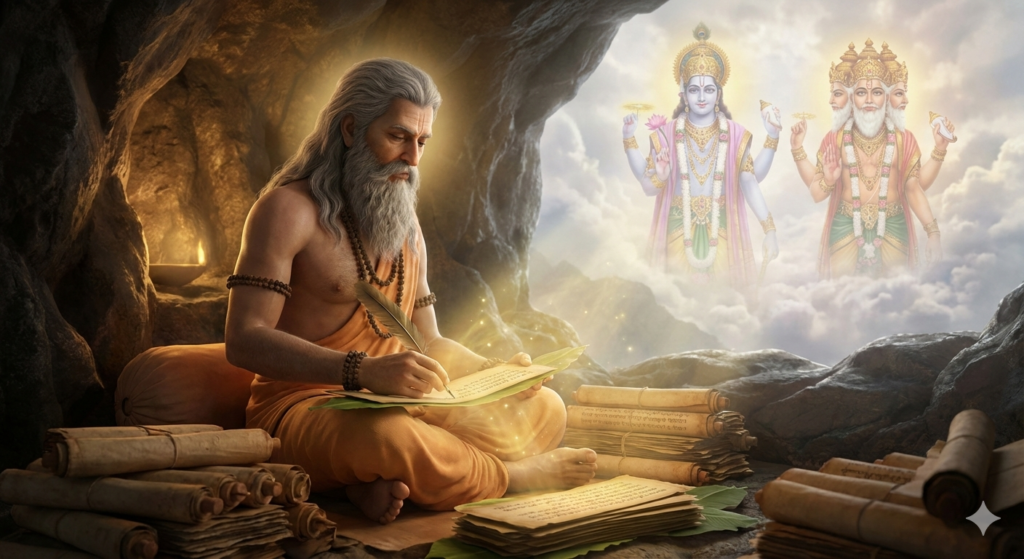
The Mahabharata is far more than the story of the Pandavas and Kauravas. It is a vast tapestry of legends that explain the very fabric of the universe. One of its most pivotal early chapters is the Astika Parva. It tells the story of how a young boy’s wisdom stopped a cycle of destruction and settled a debt of ancestors that literally hung by a thread.
The Pitru and the Burden of Lineage
The story centers on the great sage Jaratkaru, a man of fierce penance who lived a life of strict celibacy. During his travels, he encountered a sight that shook him: his ancestors, the Pitru, were hanging upside down in a dark pit. They were suspended by a single root of grass, which was being gnawed away by a rat.
When Jaratkaru asked how he could save them, they wept and explained:
“We are your ancestors, the Pitru. This single strand of grass is you—the last of our line. Because you have chosen not to marry, our lineage ends with you. When this strand breaks, we fall into eternal darkness.”
Realizing his duty toward his Pitru, Jaratkaru agreed to marry, but only on his own terms: his bride must bear his same name (Jaratkaru), must be given to him as a gift, and he would leave her if she ever disobeyed his will.
The Daughters of Daksha: The Origin of the Rivalry
To understand why a savior was needed, we must go back to the Krita Yuga. Daksha Prajapati had two beautiful daughters, Kadru and Vinata, who were both married to the great Sage Kashyapa.
Pleased with their devotion, Kashyapa offered them any boon they desired.
- Kadru asked for one thousand powerful and heroic sons (who became the Naga race).
- Vinata asked for only two sons, but requested they be more powerful and radiant than all of Kadru’s children.
Kashyapa granted these boons and gave them jars to protect the developing embryos. After five hundred years, Kadru’s thousand eggs hatched into serpents. Impatient and jealous, Vinata broke one of her eggs early. Inside was Aruna (the Dawn), who was only half-developed. Angered by his mother’s impatience, Aruna cursed her to a period of slavery under Kadru but prophesied that her second son, Garuda, would eventually liberate her.
The Curse of the Snakes
A rivalry soon broke out between the sisters over the color of the celestial horse, Uchchaishravas (refers to a divine, snow-white, flying horse in Hindu mythology, born from the churning of the cosmic ocean (Samudra Manthan)). Kadru cheated to win a wager (bet), and as a result, Vinata became her slave. Kadru then ordered her serpent sons to help her in her deceptions. When some refused, she grew furious and cursed them:
“You shall all be consumed by fire in the Sarpa Satra (Snake Sacrifice) of King Janamejaya!”
Terrified, the Serpent King Vasuki sought a solution. Brahma revealed that only a son born to the sage Jaratkaru and Vasuki’s own sister (also named Jaratkaru) could stop the fire.
The Birth of Astika and the Great Sacrifice
Vasuki gifted his sister to Jaratkaru. The marriage took place, and from it was born Astika, a child glowing with Vedic knowledge and divine grace.
Years later, King Janamejaya (the great-grandson of Arjuna) launched the Sarpa Satra to avenge his father, King Parikshit, who had been killed by the serpent Takshaka. The sacrifice was so powerful that snakes from all corners of the earth were being pulled into the sacrificial fire by the force of the mantras.
Just as Takshaka was about to be consumed, Astika arrived at the court. He praised the King’s lineage and his righteousness with such poetic brilliance that Janamejaya was moved.
“Ask for any boon, O learned boy!” the King proclaimed. “Stop this sacrifice,” Astika replied. “Let peace return to the earth and let the remaining serpents live.”
Bound by his word and urged by the gathered sages, Janamejaya halted the ritual. The serpent race was saved by the wisdom of a child.
Significance and Moral of the Story
- Dharma and Balance: Jaratkaru’s realization shows that spiritual isolation is incomplete without fulfilling one’s duty to the Pitru (ancestors) and the world.
- The Power of Forgiveness: While Janamejaya sought justice through revenge, Astika achieved a higher justice through mercy.
- Patience is Virtue: Vinata’s impatience led to a curse, reminding us that greatness (like the birth of Garuda) cannot be rushed.
Conclusion
The Astika Parva is a reminder that even the most ancient curses and the deepest vendettas can be broken by wisdom and compassion. By saving the Nagas, Astika didn’t just save a species; he preserved the cosmic balance of the world and honored his lineage.