Decoding the Akshouhini: The Incredible Mathematics of Ancient Indian Warfare
Introduction
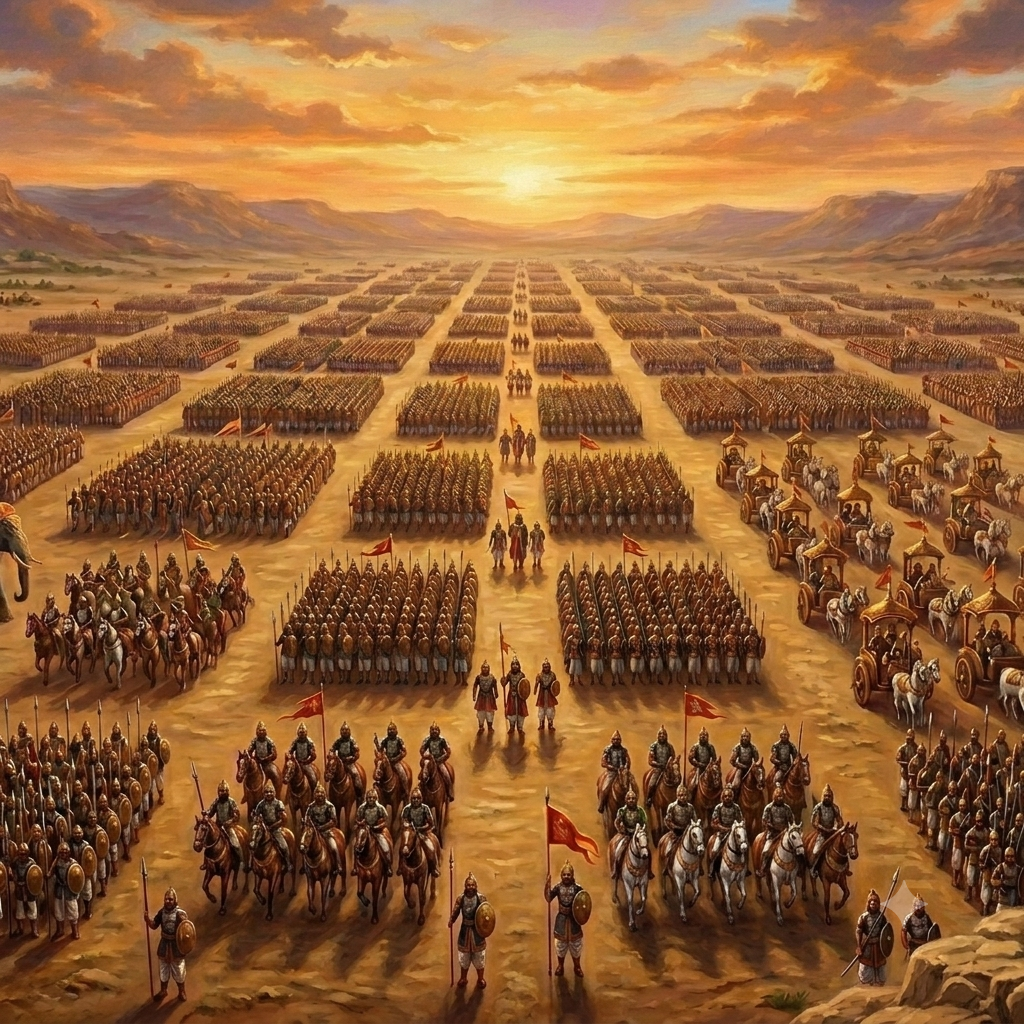
When we read epic texts like the Mahabharata, we often come across the term Akshouhini to describe the scale of the colossal armies deployed on the battlefield of Kurukshetra. But have you ever wondered exactly how an Akshouhini Sena is structured? Far from being a random gathering of warriors, it was a highly organized, mathematically precise military formation.
Based on traditional insights captured, let’s break down the fascinating structural hierarchy that builds up to a massive Akshouhini.
The Building Blocks: The base Ratio of 1:1:3:5
At the absolute base of this massive military pyramid sits a single, atomic unit called a Patti. Every single tier of the army expands dynamically from this base, maintaining a strict proportion of four distinct combat forces: chariots, elephants, cavalry (horses), and infantry (soldiers).
1 Patti consists of:
1 Chariot
1 Elephant
3 Horses/Cavalry
5 Foot Soldiers/Infantry
This is the precise 1:1:3:5 foundational ratio of ancient Indian military division.
The Step-by-Step Multiplication Hierarchy
As we climb up the ranks, each subsequent tier multiplies the previous unit by a factor of three, until the final stage which scales up by ten:
- 3 Patti = 1 Senamukhi (3 Pattis combine to form 1 Senamukhi)
- 3 Senamukhi = 1 Gulma (3 Senamukhis combine to form 1 Gulma)
- 3 Gulma = 1 Gana (3 Gulmas are called a Gana)
- 3 Gana = 1 Vahini (3 Ganas make up 1 Vahini)
- 3 Vahini = 1 Pratana (3 Vahinis are called 1 Pratana)
- 3 Pratana = 1 Chamu (3 Pratanas equal 1 Chamu)
- 3 Chamu = 1 Anikini ( 3 Chamus form 1 Anikini)
- 10 Anikinis = 1 Akshouhini (Finally, 10 Anikinis combined together constitute exactly 1 Akshouhini)
The Mind-Boggling Grand Total
When we multiply these numbers all the way to the top, the sheer volume of a single Akshouhini is staggering. By following the baseline ratio, a single Akshouhini contains exactly 21,870 Chariots. 21,870 Elephants, 65,610 Cavalry, and 109,350 Infantry soldiers—totaling 218,700 assets in just one division!
Grand Total Calculation
Because the entire army scales symmetrically based on the original 1:1:3:5 ratio, a single Akshouhini breaks down to:
Total Chariot = 1(from Patti) X 3 X 3 X 3 X 3 X 3 X 3 X 3 X 10 = 21,870
Total Elephants = 1(from Patti) X 3 X 3 X 3 X 3 X 3 X 3 X 3 X 10 = 21,870
Total Cavalry = 3(from Patti) X 3 X 3 X 3 X 3 X 3 X 3 X 3 X 10 = 65,610
Total Soldiers = 5(from Patti) X 3 X 3 X 3 X 3 X 3 X 3 X 3 X 10 = 1,09,350
Total Active Combatants per Akshouhini: 21,870 + 21,870 + 65,610 + 1,09,350 = 2,18,700
When you consider that 18 Akshouhinis (Pandavas side 7 and Kouravas side 11) fought simultaneously on the battlefield of Kurukshetra, the total number of combatants scales to nearly 3.9 million warriors interacting in perfect geometric formations.
Conclusion
The concept of an Akshouhini shows that ancient Indian warfare was deeply tied to mathematical precision and rigid structural administration.
The structural composition of an Akshouhini proves that ancient Indian warfare wasn’t merely about throwing brute strength at an enemy line. It relied heavily on complex organizational logistics, unified command tiers, and rigid mathematical discipline.
The next time you read about the massive troop counts of ancient battles, you can look back at this perfect hierarchy and visualize the staggering scale of organization.