Is the Mahabharata just a story of a great war? Or is it something more—a map of the human soul?
Beyond the Battlefield
While many know the Mahabharata for the epic conflict between the Pandavas and the Kauravas, the ancient scriptures describe it as something far more profound. It is often called the “Fifth Veda”—a massive, encyclopedic palace of knowledge designed to guide humanity through the complexities of life, death, and duty.
Based on ancient Puranic wisdom, this article explores the divine origins of this great text, the lineage of its author, and why it is described as a “lamp that dispels the darkness of the heart.”
The Divine Authorship: Who was Badarayana?
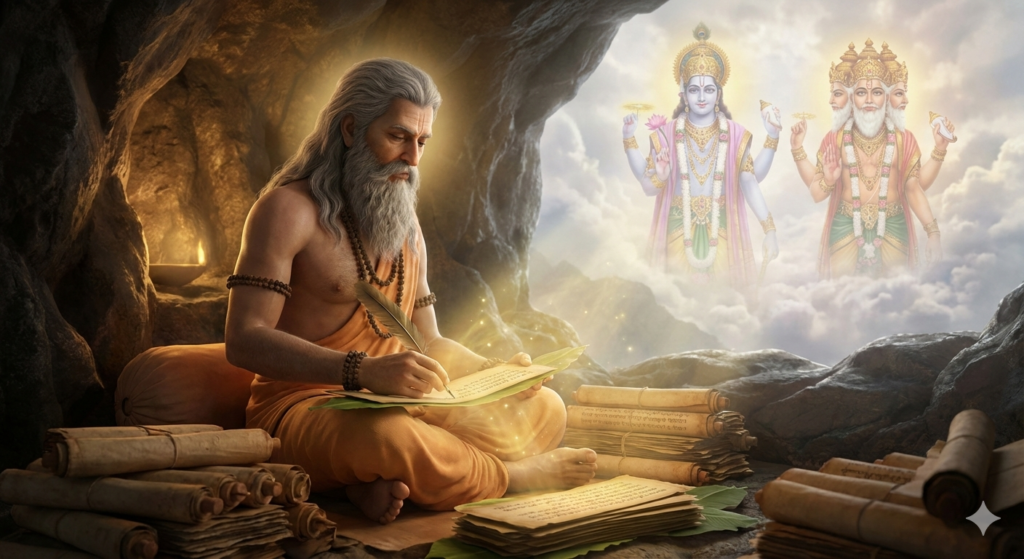
According to the Puranas, the Mahabharata was not merely written by a poet, but by a divine incarnation. The author is Badarayana, more commonly known to the world as Veda Vyasa.
The name “Badarayana” comes from the fact that he performed intense spiritual penance in the Badara (Jujube) forests of the Himalayas. The scriptures reveal that Lord Vishnu, answering the prayers of Brahma and Rudra, incarnated as Vyasa specifically to compose this text. His mission was to make the complex wisdom of the Vedas accessible to the common man during difficult times.
Did You Know? The text holds such spiritual power that it is said whoever truly understands the definition and etymology of the word ‘Mahabharata’ is freed from the weight of their sins.
The Crisis of a Lineage
The creation of the Mahabharata is deeply personal to Vyasa; he is not just the author, but the grandfather of the central characters.
Vyasa was the son of the sage Parashara and Satyavati. Years later, a crisis struck the Kuru dynasty when King Vichitravirya died without children. Faced with the end of the royal line, the Queen Mother Satyavati and the patriarch Bhishma invoked the ancient custom of Niyoga (a practice used to continue a bloodline during emergencies). They called upon Vyasa to help.
Obeying the orders of his mother, Vyasa fathered three sons who would shape history:
- Dhritarashtra:Born to Ambika (born blind).
- Pandu:Born to Ambalika (born pale).
- Vidura:Born to a maidservant (born healthy and wise).
It is the conflict between the children of Dhritarashtra (the Kauravas) and Pandu (the Pandavas) that forms the core of the epic.
The Setting: A Story Told to Stop a Slaughter
The Mahabharata was not written in a quiet room; it was first narrated during a moment of intense violence to bring peace.
Decades after the great war, King Janamejaya (the great-grandson of Arjuna) held a massive Snake Sacrifice (Sarpa Satra) to exterminate all snakes in revenge for his father’s death. During the breaks in this ritual, the King and thousands of assembled Brahmins asked to hear the history of their ancestors.
Vyasa, having finished composing the epic in the third year of his incarnation, ordered his disciple Vaishampayana to recite it. Thus, amidst the chanting of a sacrifice, the story of the Mahabharata was poured out to the world.
The “Fifth Veda”: An Encyclopedia of Life
The Mahabharata claims a bold truth: “What is found here may be found elsewhere; but what is not found here is found nowhere else.”
It incorporates the essence of the Rigveda, Yajurveda, and Samaveda, along with the Upanishads. But it goes beyond abstract philosophy. It serves as a practical manual for life, covering:
- Cosmic Science:It details the measurements of time (Yugas), and the movements of the sun, moon, and planets.
- Human Sciences:It contains knowledge of Medicine (Vaidya Shastra), Justice & Logic (Nyaya), Architecture (Vastu), and Phonetics.
- The 4 Goals of Life (Purusharthas):It is the ultimate guide to balancing Dharma (Righteousness), Artha (Wealth), Kama (Desire), and Moksha (Liberation).
The Lamp of Wisdom
Perhaps the most beautiful description of the Mahabharata is found in its own verses. It is likened to a brilliant lamp.
In a world filled with confusion, this text destroys the “veil of delusion” (Moha or Maya). It dispels the darkness that resides in the human heart and fills it with the light of clarity. Whether discussing the causes of old age and death or the remedies for fear and disease, the text offers a path forward.
A Universal Transmission
The wisdom of this text was considered too valuable to keep in one realm. Vyasa ensured it was taught across the cosmos:
- To the Gods (Devas):Recited by the sage Narada.
- To the Ancestors (Pitrus):Recited by Asita and Devala.
- To the Spirits (Gandharvas/Yakshas):Recited by Vyasa’s son, Shukacharya.
- To Humanity:Recited by Vaishampayana to King Janamejaya.
Conclusion
The Mahabharata is more than a book; it is a mirror. It shows us our struggles, our ambitions, and our potential for divinity. By studying it, we do not just learn about the past—we learn how to navigate our present.