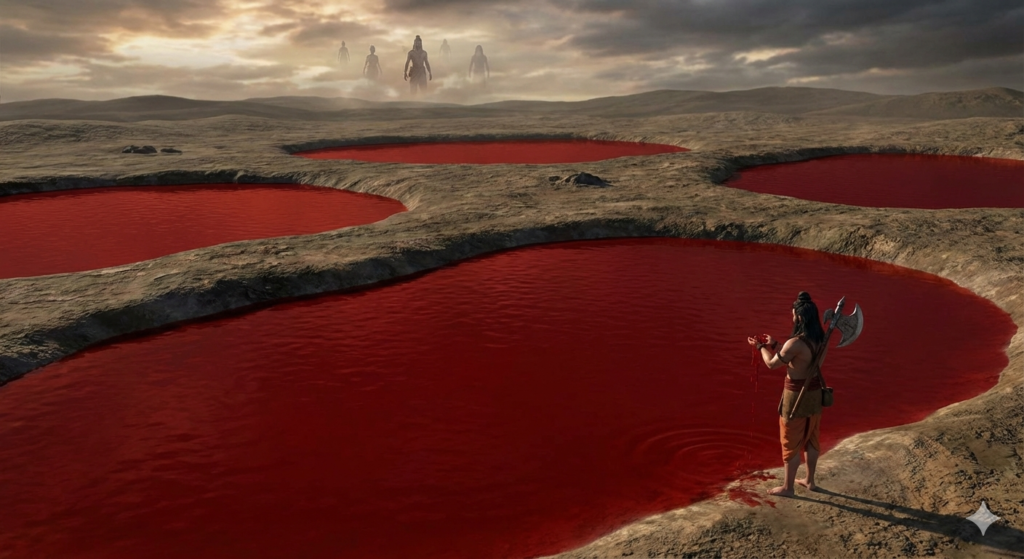
We often know Kurukshetra as the battlefield of the great Mahabharata war, where the Pandavas and Kauravas clashed. But centuries before that conflict, the land witnessed an even more terrifying purge. This is the story of Samanthapanchaka—a holy ground that was once submerged in five lakes of human blood.
Why would a sage commit such violence? What drove the legendary Parashurama to wipe out the warrior caste (Kshatriyas) twenty-one times? Based on ancient texts, we explore the fierce origins of this sacred land and the tragedy that sparked an era of vengeance.
The Era of Wrath and the Lakes of Blood
According to the legends found in the Mahabharata, the history of this land goes back to the chaotic transition between the Treta Yuga and the Dvapara Yuga. It was a time when Parashurama, the greatest of all weapon-wielders, was consumed by an uncontrollable rage.
Possessing the brilliance of Agni (Fire), Parashurama waged a relentless war against the ruling warrior class (Kshatriyas). He exterminated them not once, but many times. His wrath culminated in a specific region where he created five vast lakes filled with the blood of the fallen warriors.
Overwhelmed by his fury, Parashurama stood before these lakes of blood. In a terrifying act of devotion, he used the blood itself to perform Tarpana (sacred water oblations) to his ancestors, offering it as a tribute to their spirits. Because of these events, the region came to be known as Samanthapanchaka.
Why Did Parashurama Kill the Kshatriyas? The Story Behind the Anger
To understand the terrifying anger of Parashurama, we must look at the tragedy of his father, Sage Jamadagni.
The Greed of the King The conflict began when the powerful Kshatriya King, Kartavirya Arjuna (also known as Sahasrarjuna), visited the hermitage of Parashurama’s father. The sage possessed a divine cow named Kamadhenu, which could grant any wish. Blinded by greed and arrogance, the King demanded the cow. When the sage refused, the King forcibly stole it and destroyed the sacred ashram.
Parashurama, upon returning and seeing the destruction, pursued the King and killed him to retrieve the cow.
The Ultimate Betrayal and Vow Seeking revenge for their father’s death, the sons of Kartavirya Arjuna waited until Parashurama was away. They attacked the hermitage again and mercilessly beheaded Sage Jamadagni while he was in deep meditation. When Parashurama returned, he found his father dead and his mother, Renuka, weeping in agony. In her grief, she beat her chest twenty-one times.
Witnessing this, Parashurama’s sorrow turned into a cold, hard rage. He vowed that he would not rest until he had cleansed the earth of the corrupt Kshatriya caste twenty-one times—once for every time his mother struck her chest. This vow led to the slaughter that filled the lakes of Samanthapanchaka.
The Connection to the Great War
Centuries later, at the transition between the Dvapara Yuga and the Kali Yuga, this very land of Samanthapanchaka became the chosen battlefield for the Kuru-Pandava war.
It is said that the warriors desired to fight on this supremely holy field (Kshetra) because of its history of martial purity and sacrifice. It was here that the vast army of eighteen Akshauhinis gathered to wage the Mahabharata war, continuing the cycle of history on the blood-soaked soil of Parashurama’s legacy.
Significance of the Story:
The story of Samanthapanchaka explains the divine origin of the holy land of Kurukshetra. Before it became the battlefield for the Pandavas and Kauravas, it was already a land soaked in blood and sacrifice. It signifies the transition of eras (Yugas) and how the land was purified by Parashurama to become the “Dharmakshetra” (Field of Righteousness).
Importance: This legend highlights the consequences of abuse of power. King Kartavirya Arjuna, despite being a king whose duty was to protect, let greed destroy a sage’s hermitage. It serves as a reminder that power without humility leads to destruction. It also emphasizes the intense bond between a son and his parents (Pitru Bhakti), as Parashurama’s war was driven by love for his father and mother.
Moral of the Story:
- Anger leads to destruction:While Parashurama’s anger was justified, it led to a terrifying massacre. Unchecked rage, even for a righteous cause, can lead to endless suffering.
- The Cycle of Vengeance:Violence begets violence. The King killed the Sage, and the Sage’s son killed the entire clan. The cycle only stopped when the ancestors intervened and advised peace.
- Knowing when to stop:Even the greatest warriors must eventually lay down their weapons. True strength lies not just in fighting, but in the ability to forgive and find peace.